Key takeaways from the report
Investors often focus on demand: job growth, population growth and household formation.
For a developer, the supply side is especially important because a new community competes most directly with other new communities leasing up nearby.
Census Bureau tracks the pipeline nationally through its New Residential Construction series, which reports permits, starts, units under construction and completions, including for buildings with five or more units1.
Why supply matters as much as demand
Investors often focus on demand: job growth, population growth and household formation. Demand matters, but rents and occupancy are set by the balance between demand and supply. A metro adding many jobs can still see soft rents if a large wave of new apartments delivers at the same time. A metro with steady demand can see strong rents when new supply slows.
For a developer, the supply side is especially important because a new community competes most directly with other new communities leasing up nearby.
The stages of the supply pipeline
The U.S. Census Bureau tracks the pipeline nationally through its New Residential Construction series, which reports permits, starts, units under construction and completions, including for buildings with five or more units1. The stages are:
1. Permits. A building permit signals intent to build. Not every permit becomes a project, and timing between permit and start varies.
2. Starts. Construction begins. Starts are the most reliable early signal of future supply, because projects that break ground are very likely to be completed.
3. Under construction. The inventory of units currently being built. This is the pipeline that will deliver over the next several quarters.
4. Completions or deliveries. Units that are finished and available to lease.
5. Absorption. The net number of units renters occupy over a period. Absorption is the demand-side measure that tells you whether new supply is being filled.
How the cycle unfolds
A typical multifamily supply cycle looks like this:
Rising rents and strong occupancy make new projects attractive, so permits and starts increase.
Starts peak as many developers pursue the same opportunity at once.
Deliveries peak a few years later, after construction is complete. Lease-up competition increases and concessions rise.
New starts fall as developers see softer rents, higher costs or tighter capital markets.
Deliveries fall a few years after starts drop. Absorption catches up with the remaining new supply, occupancy improves and concessions burn off.
Rents strengthen, which eventually makes new projects attractive again.
The lag between starts and deliveries is the key insight. When starts have already fallen sharply, the pipeline a few years out is largely determined, and it is smaller.
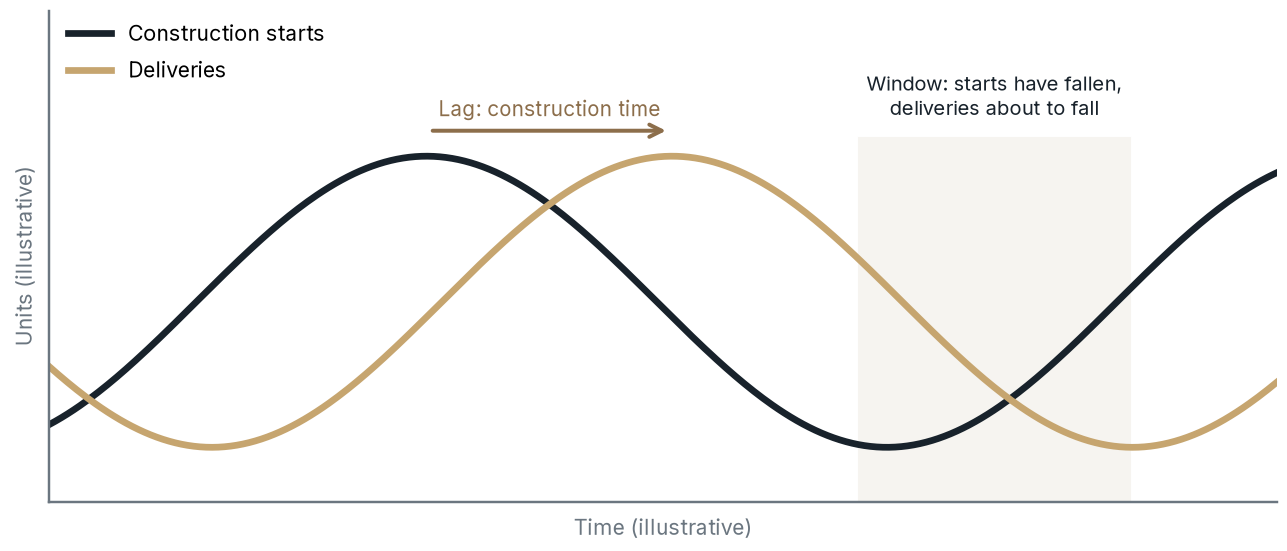
Chart Summary and Key Values
The illustrative supply cycle shows construction starts leading apartment deliveries by the construction lag. A highlighted window occurs after starts have fallen but before deliveries have fully declined. The curves are schematic: neither the unit axis nor time axis supplies numeric forecasts.
Illustrative supply cycle showing how deliveries follow construction starts with a lag. Stylized curves; no market data shown. Graphic: Ascendant Development.
Reading the signals
Starts versus deliveries. When deliveries are high but starts have dropped, the market is near the peak of new supply, and the pipeline behind it is thinning.
Units under construction. A shrinking construction pipeline means fewer new units will compete for renters in the coming quarters.
Absorption versus completions. When absorption keeps pace with or exceeds completions, new supply is being filled. When absorption trails completions, vacancy rises until deliveries slow.
Concessions. Free rent and other concessions at new communities are a real-time sign of how competitive lease-up is. Concessions typically peak with deliveries and decline as the pipeline empties.
Why this matters for development timing
A ground-up development takes time to entitle, build and lease. That means the market a developer is really underwriting is the one that will exist when the property delivers, not the one that exists today.
Starting construction when starts across the metro have fallen allows a new community to deliver as the supply wave behind it recedes. Disciplined sponsors combine that timing with conservative assumptions: current rents rather than optimistic growth, an interest reserve funded in full and sized for a longer lease-up, and reasonable exit cap assumptions. Timing improves the odds; underwriting protects the downside.
Class A and submarket detail
National figures set the backdrop, but supply competition is local. Investors should look at the submarket level and at the product class that will compete most directly with a new community. A Class A community competes mostly with other new Class A properties nearby, so Class A deliveries and
absorption in the submarket matter more than an all-vintage metro average. When reviewing any market report, check which property classes and geographies each figure covers and which data provider published it.
R E A L E X A M P L E : D F W TO DAY
Starts have fallen. Trailing 12-month multifamily starts in Dallas-Fort Worth totaled 18,442 units as of Q2 2026, down from 28,572, a decline of about 35%2.
Deliveries peaked recently. About 42,309 units were delivered in 20243.
Absorption is outpacing new supply. In Q2 2026, renters absorbed 12,042 units while 6,238 units were delivered3,4.
Figures come from different data providers and may use different definitions and geographies.
Common questions
Do permits always become supply? No. Some permitted projects never start. Starts are a more reliable signal.
How long is the lag from start to delivery? It varies by project type and size. Garden-style communities generally deliver faster than larger mid-rise or high-rise projects.
Can demand absorb a supply wave quickly? Sometimes. Strong job and population growth can absorb new units faster than expected, which is why absorption is tracked alongside deliveries.
Questions to ask a sponsor
What do starts and the construction pipeline look like in this submarket?
How many competing Class A units will be leasing up when this project delivers?
What concessions are new communities offering today, and what does the plan assume?
How is the interest reserve sized if lease-up takes longer than expected?
The bottom line
Supply is the half of the rent equation that is easiest to forecast, because today's starts determine tomorrow's deliveries. Developers who read the pipeline well, and underwrite conservatively, can deliver new communities into markets where competing supply is thinning.
A selection of Ascendant communities
NTX Denton, Denton, TX · garden Haven at Mansfield, Mansfield, TX · mid-rise Haven at Elgin, Houston, TX · high-rise
Join the Multifamily Supply Cycle Investor List
To talk through development investing with the Ascendant team, visit https:// www.ascendantdevco.com/invest-with-us or call Ascendant Development at 713.600.9393.
Join the Multifamily Supply Cycle Investor List
Sign up for Multifamily Supply Cycle investor updates →
Scan the code to join the Multifamily Supply Cycle Investor List.
S O U R C E S
1. U.S. Census Bureau, New Residential Construction (permits, starts, under construction and completions, including 5+ unit buildings). htt ps://www.census.gov/construction/nrc/index.html
2. MMG Real Estate Advisors, Dallas-Fort Worth Q2 2026 Market Report. https://mmgrea.com/dallas-fort-worth-q2-2026-market-report/
3. Matthews Real Estate Investment Services, Dallas-Fort Worth Multifamily Market Report Q2 2026. https://www.matthews.com/insights/ dallas-fort-worth-multifamily-market-report-q2-2026
4. CRE Daily, brief on Transwestern's Q2 2026 Dallas-Fort Worth multifamily data. https://www.credaily.com/briefs/dallas-fort-worth- multifamily-absorption-climbs-in-q2/
I M P O R TA N T D I S C L O S U R E S
This article is for educational purposes only and is not an offer to sell or a solicitation of an offer to buy any security. Any offering by Ascendant Development or its affiliates is made only to verified accredited investors under Rule 506(c) of Regulation D through definitive offering documents, which should be read in full, including the risk factors. Real estate development involves risk, including the possible loss of principal, and is illiquid. Nothing here is tax, legal or investment advice; consult your own advisors. Forward-looking statements are not guarantees. Hypothetical examples are for illustration only and are not projections or the terms of any offering. Photographs show completed or existing Ascendant projects. They are shown to illustrate the firm's work and do not represent any specific current offering.
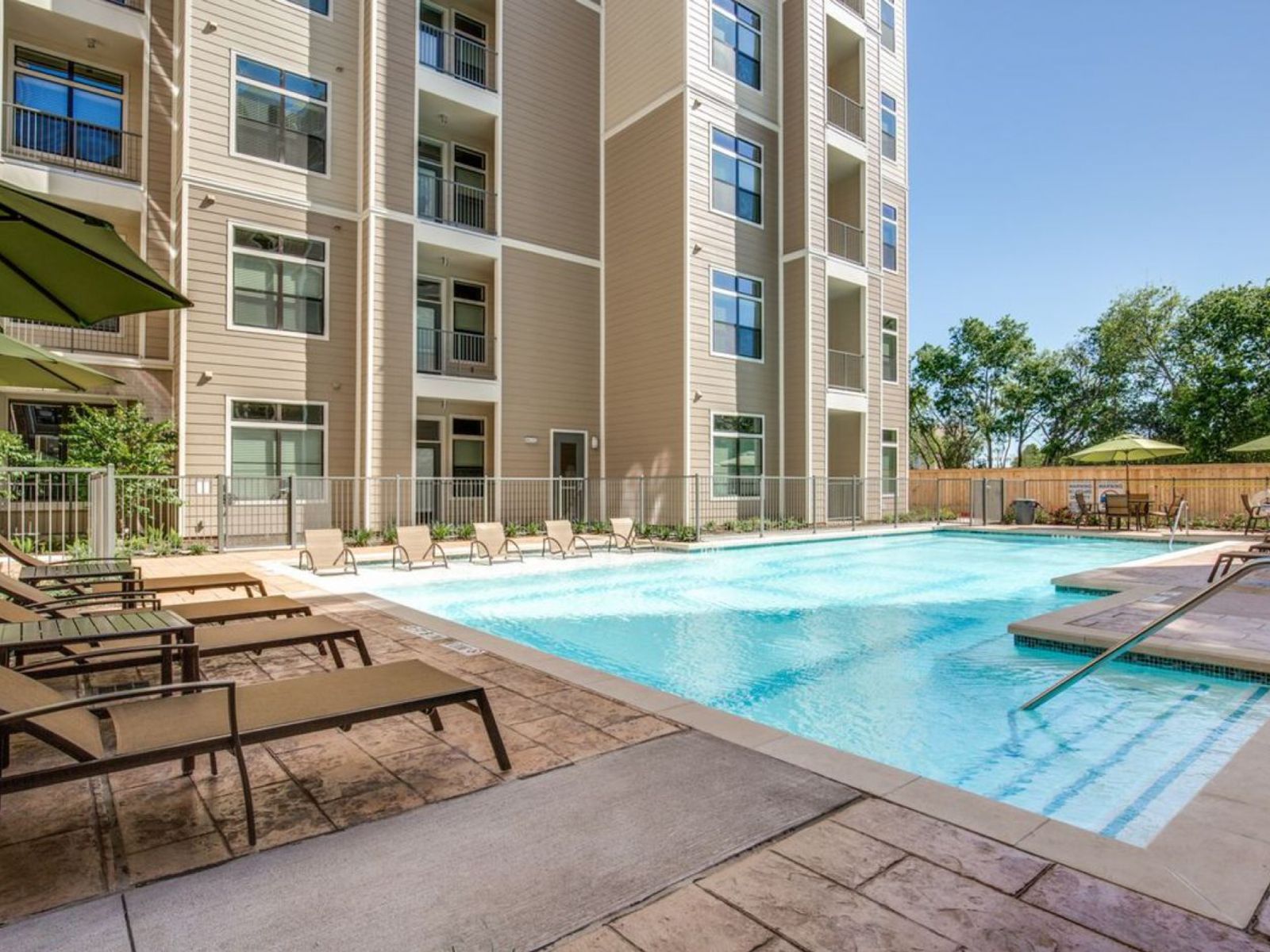
Haven at Main, Houston, Texas.
- Source 1 on report page 5
- Source 2 on report page 5
- Source 3 on report page 5
- Source 4 on report page 5
- Source 5 on report page 5
- Source 6 on report page 5
- Source 7 on report page 5
For educational purposes only. Not an offer to sell or a solicitation of an offer to buy any security. Any offering will be made only to verified accredited investors under Rule 506(c) of Regulation D through definitive offering documents. Past performance does not guarantee future results.