Key takeaways from the report
An investor who understands the timeline knows why there are no distributions during construction, which milestones signal progress and which questions to ask at each stage.
Developers screen submarkets for job growth, population and household growth, school quality, access to employment centers and the amount of competing supply under construction.
What investors should see: a clear thesis for the submarket and evidence of renter demand.
Why the timeline matters
Development rewards patience. An investor who understands the timeline knows why there are no distributions during construction, which milestones signal progress and which questions to ask at each stage. Here is how a typical Class A or build-to-rent community moves from raw land to a stabilized asset.
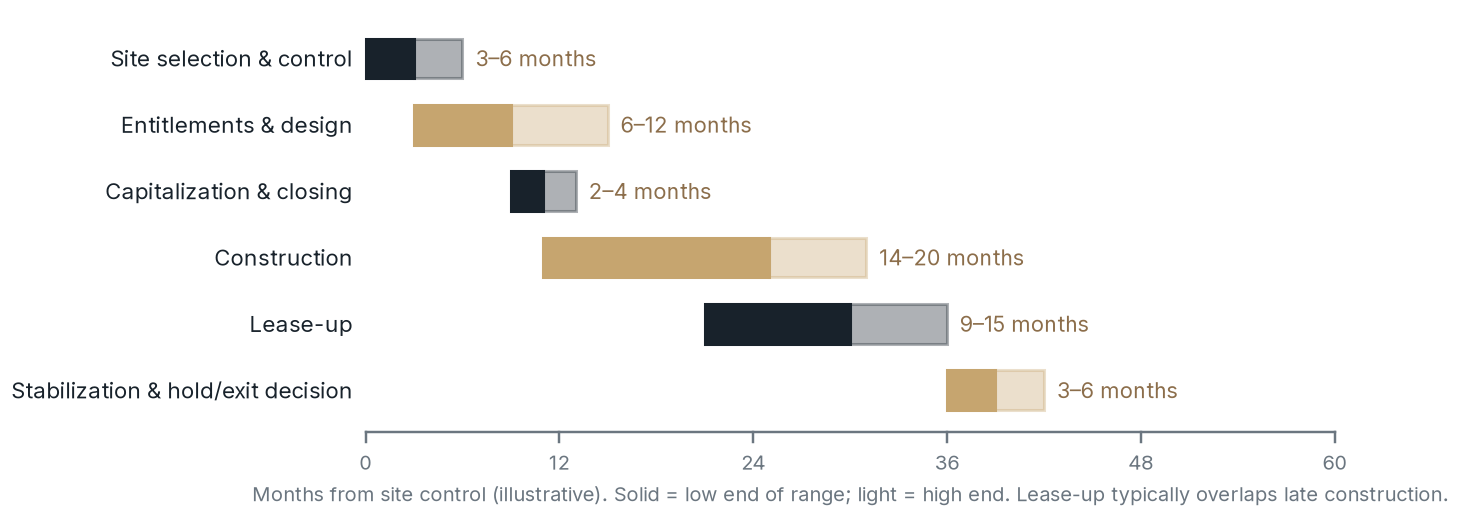
Chart Summary and Key Values
Illustrative stage durations: site selection and control 3–6 months; entitlements and design 6–12 months; capitalization and closing 2–4 months; construction 14–20 months; lease-up 9–15 months; and stabilization and hold or exit decision 3–6 months. The horizontal axis is months from site control, and lease-up typically overlaps late construction.
Typical ranges; vary by project, product type and municipality. Illustrative garden-style durations. Graphic: Ascendant Development.
Phase 1: Site selection and control
Everything starts with location. Developers screen submarkets for job growth, population and household growth, school quality, access to employment centers and the amount of competing supply under construction. A promising site is put under contract with a due-diligence period, giving the developer time to confirm zoning, utilities, environmental conditions and feasibility before committing significant capital.
What investors should see: a clear thesis for the submarket and evidence of renter demand.
Phase 2: Entitlements and design
The development team works with the city on zoning, platting, site plans and permits, while architects and engineers design the community. Unit mix, floor plans and amenities are tailored to the target renter. Early contractor involvement helps keep the design buildable within budget.
What investors should see: an approved or clearly achievable entitlement path and a design matched to submarket rents.
Phase 3: Capitalization and closing
With plans and pricing in hand, the sponsor finalizes the budget, raises equity, closes the construction loan and funds the reserves. This is where the interest reserve, sized for a longer schedule than the base case and funded in full, is put in place, along with the construction contingency. For passive investors, this is usually when capital is called and the investment formally begins.
What investors should see: a complete budget with every reserve and fee disclosed, and a construction contract with defined pricing.
Phase 4: Construction
Construction is the longest phase. It typically runs from sitework and utilities through foundations, framing, mechanical systems, finishes and amenities. On larger communities, buildings are often completed and certified for occupancy in phases, so leasing can begin before the last building is finished.
Lenders release funds through a monthly draw process, with a third-party inspector confirming progress. When the sponsor's construction company is rewarded for the same outcomes the project needs, budget and schedule decisions stay pointed in the same direction.
What investors should see: regular updates on percent complete, budget versus actual, contingency used and schedule, with photos from the site.
S A M P L E Q U A R T E R LY C O N S T R U C T I O N U P DAT E
| Item | This quarter |
|---|---|
| Construction percent complete | 62% |
Total project budget $60.0M Costs to date: actual vs. plan $34.8M vs. $35.2M Contingency used $0.6M of $2.5M (24%) Interest reserve remaining $4.3M of $6.2M ($1.9M used) Schedule First building certificate of occupancy on
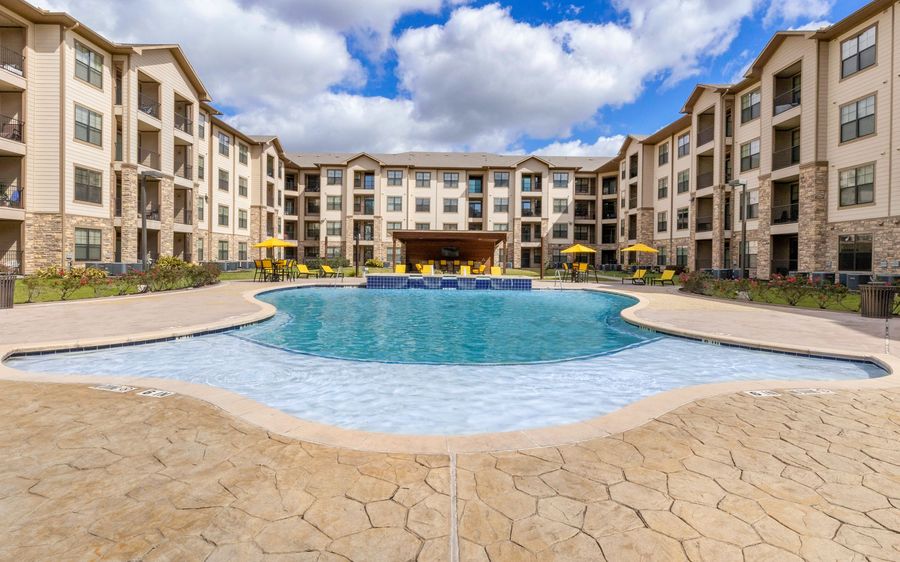
Site photo placeholder. A finished Ascendant community (Haven at Westheimer, Houston, TX) is shown for layout only.
track
Illustrative format; not actual project data.
Phase 5: Lease-up
As buildings deliver, the leasing team markets the community, tours prospects and signs leases. Early concessions are common in new communities and taper as occupancy builds. The pace of lease-up depends on the submarket, the amount of competing new supply and the quality of the product and team.
What investors should see: monthly leasing velocity, occupancy, effective rents versus underwriting and concession trends.
Phase 6: Stabilization and the hold or exit decision
A community is generally considered stabilized when occupancy and operations reach a steady state. At this point, the property has a track record of income that buyers and lenders can value. The sponsor then follows the business plan in the offering documents, which may include continuing to hold, refinancing, or selling the property.
What investors should see: distributions as described in the offering documents and clear communication about the hold, refinance or sale decision.
How long does it take?
Timelines vary with project size, product type, municipality and market conditions. Garden-style and build-to-rent communities can move faster than larger mid-rise projects. Census data show that apartment buildings with 20 or more units started in 2022 took an average of 18.1 months from start to completion, and that figure covers construction only, not site work before the start or lease-up after it1. Your offering documents should spell out the projected schedule and the assumptions behind it, and the interest reserve should be sized for a longer schedule than the base case.
What can change the timeline
Permitting and inspection delays
Weather and site conditions
Labor and materials availability
The pace of lease-up in the submarket
Experienced sponsors build these possibilities into their schedules and reserves rather than assuming everything goes to plan.
Investor communication at each phase
A good sponsor's reporting changes as the project moves through its life cycle:
At closing: final budget, sources and uses, construction schedule, reserve balances and the construction contract structure
During construction: monthly or quarterly progress reports with site photos or drone footage, percent complete, budget versus actual, contingency usage and schedule updates
During lease-up: leasing velocity, occupancy, effective rents versus underwriting, concessions and resident feedback
At stabilization: operating results, the updated business plan and any hold, refinance or sale decisions
Every year: K-1s and tax information on a predictable timeline
If you are evaluating a sponsor, ask for a sample report from each phase of a completed project. The quality and candor of past reporting is one of the best predictors of the experience you will have as an investor.
Phased delivery and early leasing
On larger communities, buildings are typically delivered in a planned sequence. Early buildings can begin leasing while later buildings are finished. This shortens the time between closing and first rental income, helps the leasing team build momentum and gives the sponsor early, real-world feedback on rents and concessions. The interest reserve continues to cover carrying costs until rental income is sufficient.
The bottom line
A development is a multi-year journey with a predictable sequence. Investors who know the phases can follow progress with confidence, ask sharper questions and judge a sponsor by how well it communicates at every milestone.
A selection of Ascendant communities
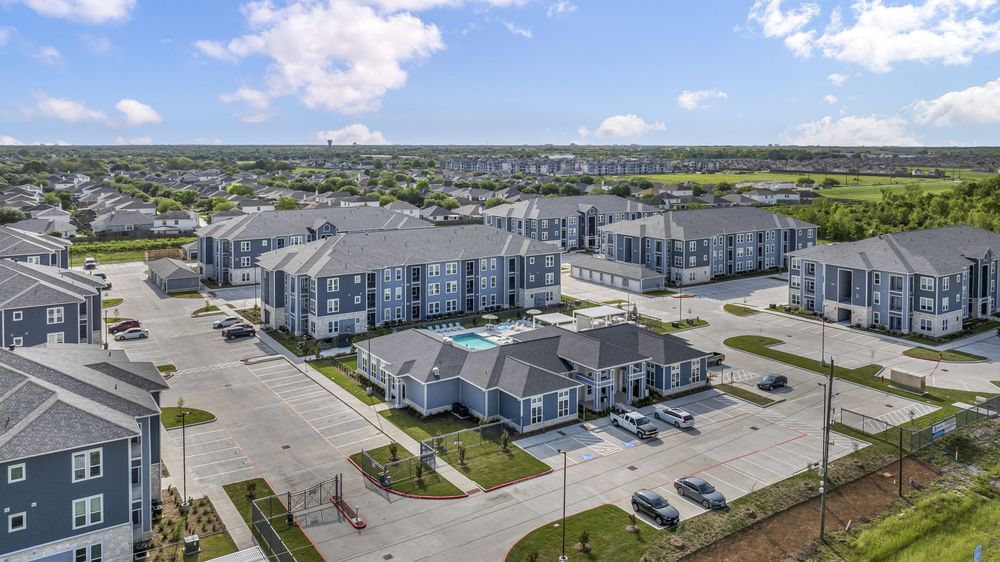
Haven at Mission Trace, Richmond, TX · garden
Preserve at HWY 6, Fresno, TX · cottage Haven at Thorpe Lane, San Marcos, TX · mid- rise
Join the From Dirt to Stabilization Investor List
To talk through development investing with the Ascendant team, visit https:// www.ascendantdevco.com/invest-with-us or call Ascendant Development at 713.600.9393.
Join the From Dirt to Stabilization Investor List
Sign up for From Dirt to Stabilization investor updates →
Scan the code to join the From Dirt to Stabilization Investor List.
S O U R C E S
1. U.S. Census Bureau, Average Length of Time from Start to Completion of New Privately Owned Residential Buildings. https:// www.census.gov/construction/nrc/pdf/avg_starttocomp.pdf
I M P O R TA N T D I S C L O S U R E S
This article is for educational purposes only and is not an offer to sell or a solicitation of an offer to buy any security. Any offering by Ascendant Development or its affiliates is made only to verified accredited investors under Rule 506(c) of Regulation D through definitive offering documents, which should be read in full, including the risk factors. Real estate development involves risk, including the possible loss of principal, and is illiquid. Nothing here is tax, legal or investment advice; consult your own advisors. Forward-looking statements are not guarantees. Hypothetical examples are for illustration only and are not projections or the terms of any offering. Photographs show completed or existing Ascendant projects. They are shown to illustrate the firm's work and do not represent any specific current offering.
- Source 1 on report page 5
- Source 2 on report page 5
- Source 3 on report page 5
- Source 4 on report page 5
For educational purposes only. Not an offer to sell or a solicitation of an offer to buy any security. Any offering will be made only to verified accredited investors under Rule 506(c) of Regulation D through definitive offering documents. Past performance does not guarantee future results.