Key takeaways from the report
Imagine two investors who each want to own a 300-unit Class A apartment community in the same submarket.
The first investor pays what the market says the property is worth, and the seller keeps the value created during development.
They simply put the investor at different points in the life of the asset.
The basic idea
Imagine two investors who each want to own a 300-unit Class A apartment community in the same submarket. The first buys a recently completed property from a developer. The second partners with a developer to build a comparable property from the ground up.
The first investor pays what the market says the property is worth, and the seller keeps the value created during development. The second investor takes on the work and the time of building, and in exchange owns a property whose total cost was designed to sit below its stabilized value.
Both are legitimate strategies. They simply put the investor at different points in the life of the asset.
Fair market value: what an acquisition buys
In an acquisition, price is set by competition among buyers. A broker markets the property, bidders submit offers, and the winning price reflects what buyers will pay for the current income and expected future income. The new owner's return depends on running the property better, raising rents, renovating units or buying when pricing is favorable.
There is nothing wrong with that model, but the investor starts at full value. Any profit the developer earned in creating the property has already been captured by the seller.
Cost basis: what development builds
In development, the investor's basis is the sum of:
Land, purchased or contributed
Hard costs: sitework, vertical construction, finishes and amenities
Soft costs: architecture, engineering, permits, impact fees, legal and insurance
Financing costs and reserves, including a fully funded interest reserve
Developer and construction fees, disclosed in the offering documents
If the project is delivered on budget and leased at market rents, the stabilized property can be valued the same way any acquisition is valued: by its net operating income divided by a market capitalization rate. When that value exceeds total cost, the difference is value created, and it belongs to the owners of the project, including the passive investors.
Why the gap exists
Developers are compensated for risks and work that a buyer of a finished asset does not take on: securing entitlements, managing construction, carrying the project before it produces rent, and leasing a new property from zero occupancy. The market pays for completed, stabilized income. The development process is how that income gets created.
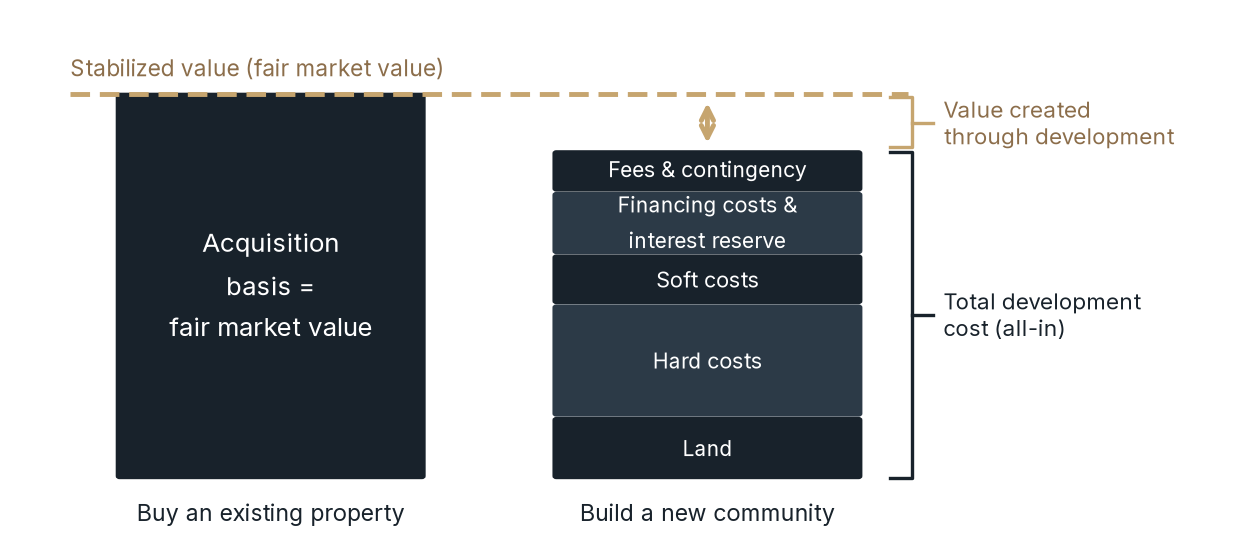
Chart Summary and Key Values
Schematic comparison: purchasing an existing property starts with an acquisition basis equal to fair market value. Development all-in cost includes land, hard costs, soft costs, financing costs and interest reserve, fees and contingency. The difference between stabilized fair market value and total development cost illustrates value created through development. No dollar values or guaranteed spread are assigned to these not-to-scale blocks.
Illustrative comparison of an acquisition basis and a development cost basis. Not to scale; actual costs and values vary by project. Graphic: Ascendant Development.
What the investor takes on in exchange
Development is not a free lunch, and investors should understand the trade.
Time. Construction and lease-up typically run multiple years before the property is stabilized.
No early income. Distributions generally begin once the property is leased, not during construction.
Execution risk. Cost overruns, delays and slower-than-expected leasing can reduce the gap between cost and value.
Experienced sponsors address these risks directly. They fund a conservative interest reserve at closing so carrying costs are covered through construction and lease-up. They use contingencies and fixed- price construction contracts. They underwrite reasonable exit cap assumptions instead of counting on market improvement. The strongest sponsors also make sure their construction company's incentives line up with what the project needs.
Measuring the gap: yield on cost vs. cap rate
Investors often compare two numbers to judge whether a development makes sense:
Yield on cost is the stabilized net operating income divided by total project cost.
Market cap rate is the net operating income divided by price for comparable stabilized properties that trade.
When yield on cost is meaningfully above the market cap rate, the project is expected to be worth more than it cost to build. The wider that spread, the more cushion the project has against higher costs or softer rents.
When buying makes more sense, and when building does
Acquisitions can make sense when sellers are under pressure and properties trade at discounts, or when an investor wants immediate cash flow. Development tends to make sense when the cost to build a new property is below what comparable new properties sell for, and when the supply pipeline is thinning so new deliveries face less competition.
A simple illustration
Consider a submarket where newly built Class A communities have recently traded to buyers. Those sales tell a developer what the market will pay for a finished, leased property of that quality. The developer then prices land, construction, soft costs, financing costs and reserves for a comparable new community on a nearby site.
If the full cost to build is meaningfully below what buyers have been paying for similar finished properties, the project has a development margin. If building costs as much as buying, there is no reason to take on construction and lease-up risk, and a disciplined sponsor will pass.
H Y P OT H E T I CA L I L L U S T R AT I O N : A 3 0 0 - U N I T C O M M U N I T Y

Table Summary and Key Values
| Total | Per unit | |
|---|---|---|
| Buy: a comparable new community trades at | $78.0M | $260K |
| Build: all-in cost to create a comparable community | $60.0M | $200K |
| Development margin ($78.0M − $60.0M) | $18.0M | $60K |
Arithmetic: 300 units × $260K = $78.0M; 300 units × $200K = $60.0M. The $18.0M margin equals 30% of the all-in cost. Higher costs, lower rents or weaker pricing at completion would reduce it.
Hypothetical example for illustration only. Not a projection or the terms of any offering.
That comparison is why construction costs, land prices and recent trades are so central to every development decision. When building costs stay flat while values for new product hold steady, the margin widens. When land and construction costs climb faster than values, it narrows, and new starts slow1. That slowdown in turn reduces future supply, which helps the projects that do get built.
Questions to ask about any build-versus-buy decision
What have comparable new properties in this submarket recently sold for?
What is the total cost to build this project, including every reserve and fee?
How large is the margin between cost and expected stabilized value?
How much could costs rise or rents fall before the margin disappears?
What supply is under construction nearby, and when does it deliver?
The bottom line
Buying puts an investor at fair market value. Building, done well, puts an investor at a cost basis below it. The difference is earned through execution, which is why the experience of the sponsor, the strength of the reserves and the alignment of the construction team matter so much.
A selection of Ascendant communities
Amplify Tomball, Tomball, TX · build-to-rent townhome
Haven at Thorpe Lane, San Marcos, TX · mid- rise
Haven at Bellaire, Richmond, TX · garden
Join the Build vs. Buy Investor List
To talk through development investing with the Ascendant team, visit https:// www.ascendantdevco.com/invest-with-us or call Ascendant Development at 713.600.9393.
Join the Build vs. Buy Investor List
Sign up for Build vs. Buy investor updates →
Scan the code to join the Build vs. Buy Investor List.
S O U R C E S
1. U.S. Census Bureau, New Residential Construction (housing starts and completions). https://www.census.gov/construction/nrc/ index.html
I M P O R TA N T D I S C L O S U R E S
This article is for educational purposes only and is not an offer to sell or a solicitation of an offer to buy any security. Any offering by Ascendant Development or its affiliates is made only to verified accredited investors under Rule 506(c) of Regulation D through definitive offering documents, which should be read in full, including the risk factors. Real estate development involves risk, including the possible loss of principal, and is illiquid. Nothing here is tax, legal or investment advice; consult your own advisors. Forward-looking statements are not guarantees. Hypothetical examples are for illustration only and are not projections or the terms of any offering. Photographs show completed or existing Ascendant projects. They are shown to illustrate the firm's work and do not represent any specific current offering.
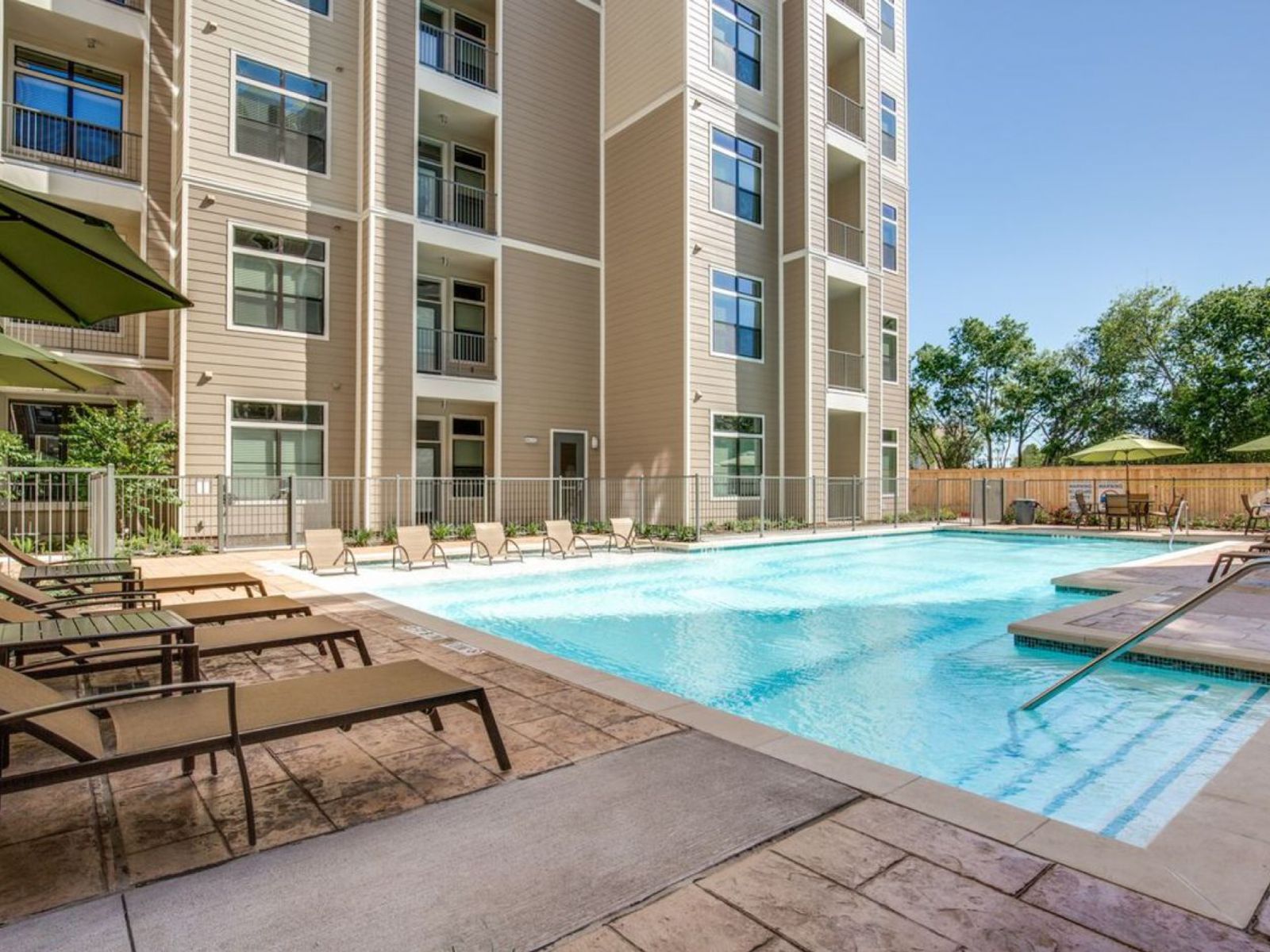
Haven at Main, Houston, Texas.
- Source 1 on report page 5
- Source 2 on report page 5
- Source 3 on report page 5
- Source 4 on report page 5
For educational purposes only. Not an offer to sell or a solicitation of an offer to buy any security. Any offering will be made only to verified accredited investors under Rule 506(c) of Regulation D through definitive offering documents. Past performance does not guarantee future results.